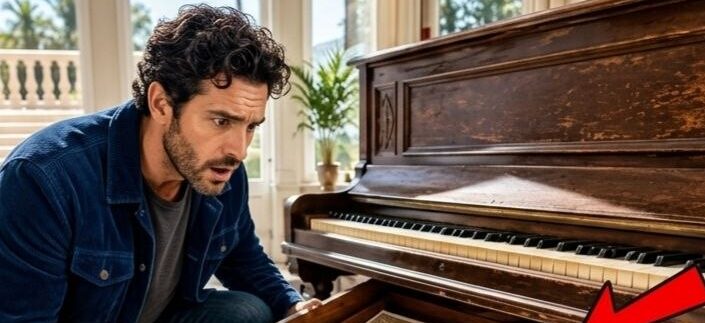
His family took everything he owned, leaving him with nothing but a broken old piano—until a hidden compartment inside it revealed a secret that would change his life forever.
Don Esteban had discovered the truth about Arturo long before his death.
His eldest son had been secretly moving money through shell companies, forging signatures, and using the employees’ retirement fund to finance fraudulent deals.
Verónica was involved too. She had allowed valuable family artwork to be used as collateral for illegal loans.
From the outside, Grupo Villaseñor looked unstoppable. Behind closed doors, however, the company was drowning in debt.
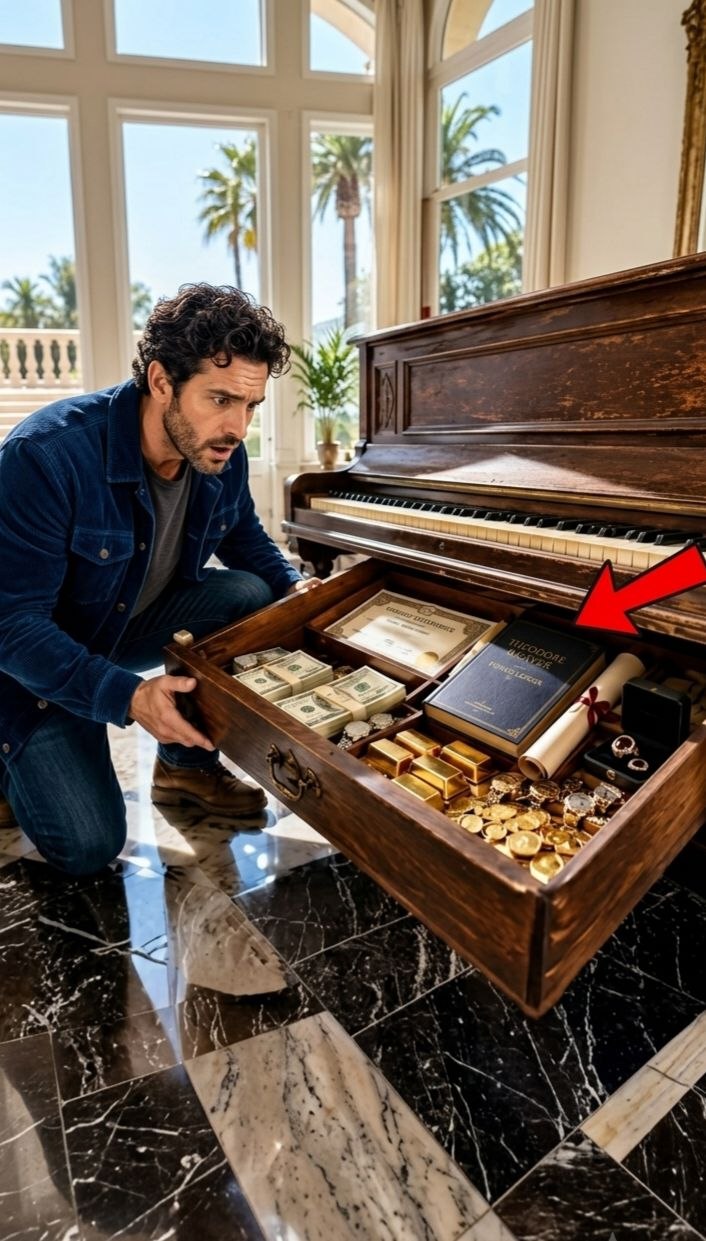
In the letter hidden inside the piano, Don Esteban had written: “I tried to stop them, but my mind began to fail me. Arturo wanted to have me declared mentally incompetent so he could take control of everything.
That is why I hid the family’s legitimate assets in certificates and untraceable gemstones. This notebook contains the evidence of their crimes. I did not leave you worthless junk, Mateo.
I left you the truth. Now you must decide whether to destroy them out of hatred—or save whatever is still worth saving.” For the first time since the funeral, Mateo cried.
His father hadn’t forgotten him. He had trusted him. As Mateo went through the notebook, he discovered something even more urgent.
Arturo planned to merge Grupo Villaseñor with a foreign corporation in less than ten days.
Once the deal was completed, he intended to move the remaining money into private accounts and leave the company’s debts to the investors.
Thousands of employees could lose their pensions. Mateo didn’t have time to grieve. He sold two of the diamonds hidden inside the piano and raised more than 25 million pesos.
But he didn’t spend the money on himself. Instead, he hired Adriana Salgado, a lawyer specializing in corporate fraud, along with a team of forensic accountants.
For hours, they examined bank transfers, financial records, shell companies, and accounts connected to businesses registered in Panama, the Cayman Islands, and Delaware.
Eventually, Adriana looked up. “Your brother didn’t simply steal money,” she said. “He built an enormous fraud using your father’s name. If he completes the merger, he’ll walk away with hundreds of millions.”
Mateo handed the evidence to the authorities and to the investors’ legal teams. The suspicious accounts were frozen, but the investigation remained confidential.
The merger agreement was scheduled to be signed during a lavish gala at a luxury hotel on Mexico City’s Reforma Avenue.
Arturo planned to announce the deal surrounded by businessmen, investors, and journalists. That evening, he arrived looking like a man who believed he had already won.
He was convinced he was about to become one of the richest men in the country. Then the ballroom doors opened. Mateo walked in. Adriana was beside him, followed by federal agents.
He was no longer the defeated man everyone had seen at his father’s funeral. He wore a simple suit and carried himself with quiet confidence.
Arturo laughed when he saw him. “Did you come here looking for a job?” he mocked. “Or did you finally sell that piano for firewood?”
Mateo looked at him calmly. “The piano was worth far more than you realized.” “It was worthless.” “No,” Mateo replied. “It was a vault.” The room fell silent. Mateo began presenting the evidence.
“Inside that piano were records of the companies you used to hide money, fraudulent loans, and proof that you diverted 680 million pesos from the employees’ retirement fund.”
Arturo immediately denied everything. But Mateo wasn’t finished.
He produced documents showing that Arturo had forged signatures and authorized transactions while their father was suffering from dementia.
Arturo lost his composure. “Security!” No one moved. Instead, the federal agents stepped forward and displayed their credentials.
“Arturo Villaseñor, you are under arrest for financial fraud, money laundering, forgery, and fraudulent administration.” Verónica tried to defend herself.
Adriana presented documents showing that she had also participated in the scheme. Verónica claimed Arturo had told her every transaction was legitimate.
The evidence proved otherwise. The merger was canceled. The investors withdrew.Within days, the truth became public.
As officers led Arturo away, he turned toward Mateo in fury.“You could have shared the money!” Mateo looked at his brother sadly.
“Family was never about the money. It was about the man you abandoned when he had nothing left to give you.” Arturo was sentenced to 18 years in prison.
Verónica avoided a harsher sentence after cooperating with investigators, but she lost her properties, her wealth, and the life she had built.
Mateo chose not to destroy the Villaseñor name.
Instead, he used part of the inheritance to pay legitimate debts, preserve the profitable companies, and protect the employees’ pensions.
He established an independent board made up of employees, accountants, and outside experts.
“This company will never again be a monument to family greed,” he said. “If it carries our name, then that name must stand for something better.” He also reclaimed the Los Laureles estate.
Rather than turning it into another luxury property, Mateo transformed it into a support center for people living with dementia and their families.
Part of the estate became a free music school called Casa Esteban. One day, Verónica arrived carrying a small box filled with old letters.
They were letters Mateo had written to his father during his illness. Arturo had hidden them. “He told us Dad didn’t want to see us,” Verónica confessed.
“It was easier to believe him than to admit that we had abandoned our father.” Mateo didn’t forgive her immediately. But he gave her a chance to make things right.
Over time, Verónica began working at Casa Esteban. She studied geriatric care and eventually became the center’s coordinator.
One year later, the old 1892 piano was moved into the main hall. Mateo sat down and played the melody he had once shared with his father as a child.
The piano was no longer a symbol of loss. It had become a reminder of love, truth, and second chances.
Months later, Mateo and Adriana married at the estate. There were no politicians, extravagant displays, or lavish ceremonies.
Only employees, neighbors, children, friends, and families filled the grounds. Arturo never apologized. Even from prison, he continued blaming everyone except himself.
Eventually, Mateo stopped waiting for an apology that would never come.
He understood that a happy ending doesn’t always mean getting back the people who walked away.
Sometimes, it means building something meaningful from whatever remains.
His siblings had believed that leaving him with a broken piano meant they had taken away everything of value.
They had failed to understand one simple truth: Some people only recognize wealth when it shines.
Don Esteban knew that his greatest inheritance was never the gold, diamonds, or financial certificates.
It was the chance to repair what had been broken. To protect the people his family had betrayed.
And to restore the dignity they had nearly destroyed. That was why he left the piano to Mateo.
Because he knew that Mateo was the only one who would understand that even broken things can hold a story—and sometimes, that story is worth saving.