“WE DON’T TREAT BEGGARS HERE!”
The hospital lobby had been designed to keep suffering out.
Polished marble floors. Soft instrumental music. A faint citrus scent drifting through the air.
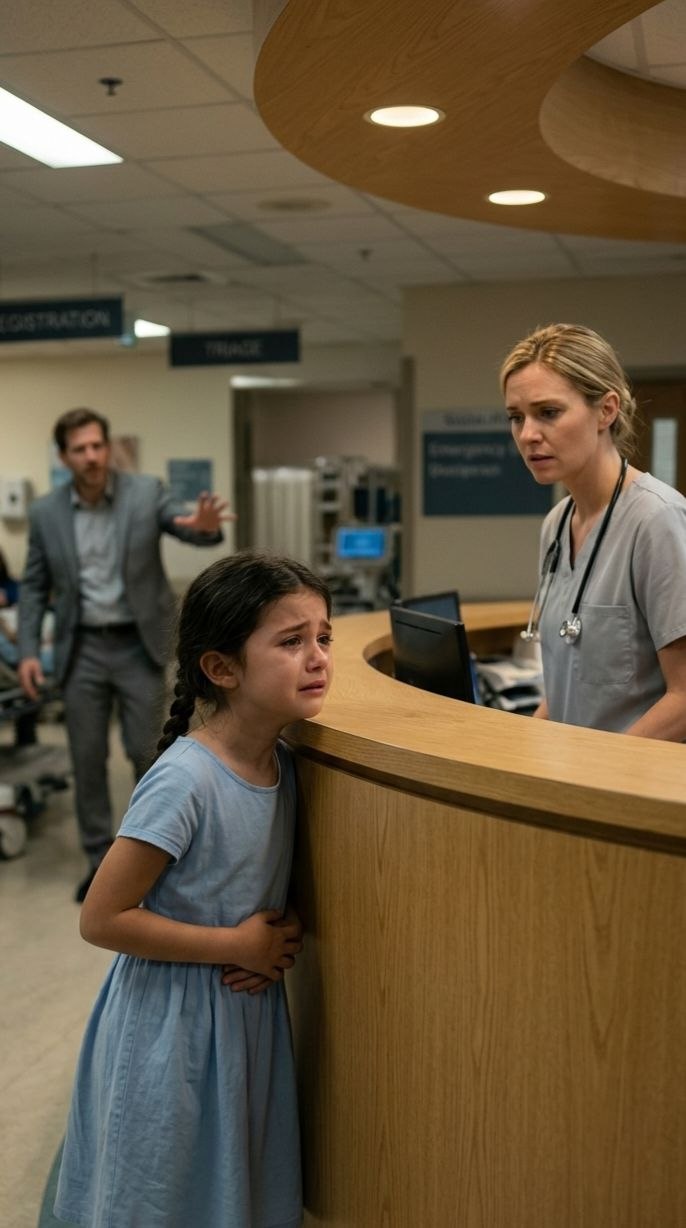
Everyone moved carefully, almost as if pain itself had no place inside those walls. That was why the little girl stood out so much. Eight years old. Barefoot.
Shivering so badly that she could barely remain standing. Her dirty hands left faint marks on the spotless reception counter as she whispered: “Please… I need a doctor.”
The receptionist didn’t even bother looking up. “This is a private hospital,” she said coldly. “We don’t treat beggars.” The girl swallowed hard.“It hurts.”
Two security guards began moving toward her. Around them, the adults looked away. One man suddenly became interested in his watch. A mother turned her child in the opposite direction.
Silence settled over the lobby like a blanket of guilt. “Please,” the girl begged, gripping the edge of the counter. Her knees suddenly gave out.
She collapsed onto the marble floor. And still, nobody moved. “Get her out of here!” the receptionist ordered.
That was when a simply dressed man rose from his seat. He crossed the lobby with slow, deliberate steps and stopped beside the trembling child lying on the floor.
For the first time since she had entered the hospital, someone truly saw her. His voice was calm. “Give her to me.” One of the guards hesitated. Jonas didn’t.
He carefully lifted the unconscious girl and placed her into the man’s arms. He held her gently, as though she were made of glass. The receptionist hurried after them.
“She needs paperwork! And a deposit!” “She needs a doctor,” the man replied. “Now.” “And who’s going to pay for it?”
“I am.” A sharply dressed administrator stepped forward.
“Either you provide proof of payment, or we’ll have security remove you and send the girl to a public hospital—where she belongs.”
The words were cold. Deliberately cruel. The man calmly took out his phone. “Give me the hospital account number,” he said to the accountant.
Seconds later, a new balance appeared on the screen: $2,000,000. The hallway fell silent. The administrator stared at the screen. “Who are you?” he whispered.
The man barely looked at him.“That doesn’t matter.” Then he looked toward the emergency team. “Save her.”
Doctors rushed forward, taking the girl to the emergency department. Only then did the man turn back. “My name is Artur Monteiro.”
The color drained from several faces. Artur looked around the lobby. “How many children,” he asked quietly, “have you turned away because helping them wasn’t profitable?”
No one answered. “Emergency meeting,” Artur said into his phone. Then he added: “And prepare the termination papers for Dr. Valadares.”
Hours later, Artur sat outside the pediatric intensive care unit. Years ago, he had been a father. He had once believed money could solve anything.
He had learned the hardest possible way that it couldn’t. That was why he could never walk past a suffering child without stopping.
A woman named Helena approached him. “Her name is Lia,” she said softly. “She has no family and no identification. She came here alone.” Artur closed his eyes.
The surgery lasted for hours. When it finally ended, the doctor stepped out. “She’s stable.” Artur exhaled slowly.
While searching Lia’s belongings, a nurse found a thin bracelet around her wrist. It had only one faded charm: **L.** Artur froze.
His daughter, Lúcia, used to make bracelets exactly like that. Two days later, Lia opened her eyes. “Did they throw me out?” she whispered. “No,” Artur said gently. “No one will ever do that to you again.”
Lia stared at him. “Are they going to send me away?” Artur leaned closer. “If you want… you can stay with me.” The little girl hesitated.
Then she slowly nodded. “Okay.” And just like that, a child who had spent so long alone no longer had to be.
One year later, the hospital lobby still gleamed beneath the lights. But something had changed. Now, children were welcomed through those doors. Beside the entrance stood a new plaque:
THE LÚCIA MONTEIRO FOUNDATION — EVERY CHILD DESERVES A CHANCE
Lia stood beside Artur, holding a box filled with donated toys. “This is where they saved me,” she said.
Then she smiled. “So we have to help other children too.” Artur smiled back.
For the first time since losing his daughter, he wasn’t simply a powerful man trying to fill an empty space. He was a father again.