
THE EXHAUSTED WAITRESS GAVE A BOWL OF SOUP TO A STRANGER—THE NEXT DAY, SHE DISCOVERED WHO THE WOMAN REALLY WAS
An Exhausted Waitress Gave a Stranger a Bowl of Soup—She Had No Idea the Woman’s Son Would Change Her Life Forever
The spoon slipped from the elderly woman’s trembling fingers and shattered on the floor.
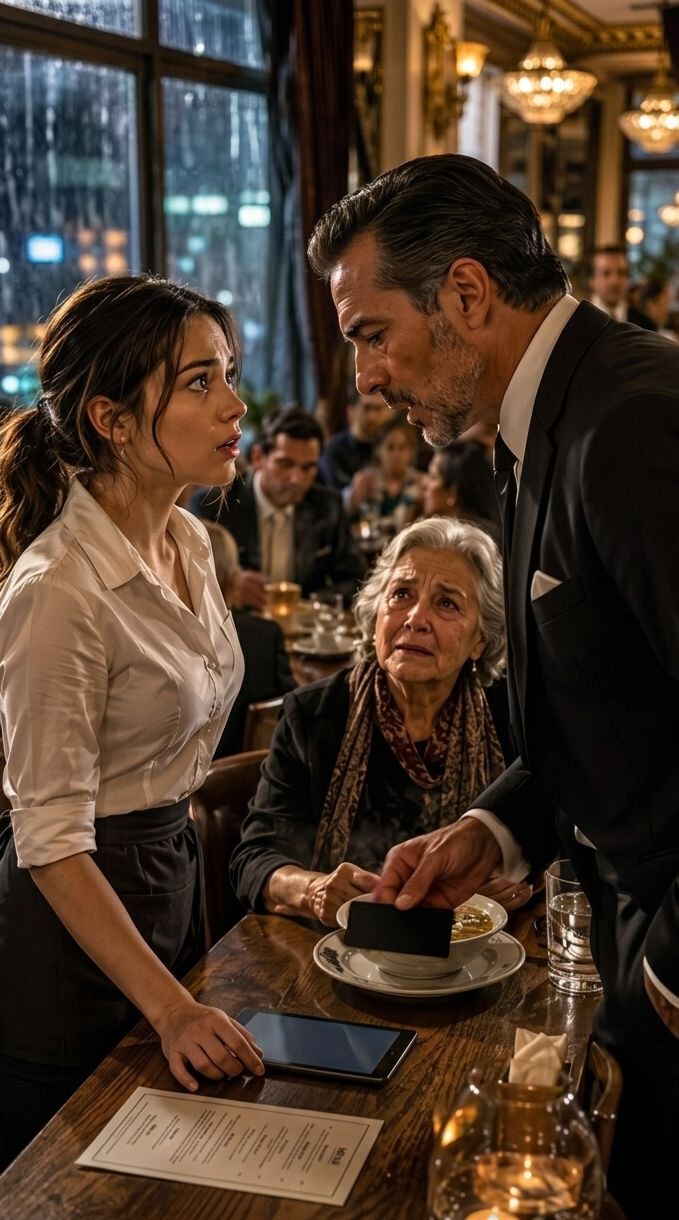
Almost everyone in the crowded restaurant ignored it. Emily Carter didn’t. Rain poured over Mexico City, and the restaurant was struggling through the dinner rush.
Emily had already been on her feet for eleven hours. She was exhausted, hungry, and desperate for a few minutes to sit down.
Then she noticed the elderly woman struggling with her meal. Her hands were shaking so badly that she could barely hold the spoon.
“Some days,” the woman whispered, embarrassed, “even eating feels like hard work.” Emily’s heart sank. She hurried into the kitchen.
“She needs some soup.” Her manager, Rodrigo, looked up. “We don’t serve soup.” “There’s some in the staff pot.” “That’s for the employees.”
Emily glanced at the untouched meal that had been waiting for her. “Then give her mine.” Rodrigo stared at her. “You haven’t eaten all day.”
“I know.” He sighed. “Emily, you can’t keep trying to save every customer who has a problem.” Emily shook her head. “I’m not trying to save her. I’m just trying to help her eat.”
A few minutes later, Emily returned with a bowl of homemade chicken soup and a spoon with a larger handle that would be easier for the woman to hold.
“There’s no need to hurry,” Emily said. “Take your time.” The woman wrapped both hands around the warm bowl.
For the first time that evening, her face softened into a genuine smile. “Thank you.” Emily smiled. “It’s just soup.”
The woman looked at her for a long moment. “No,” she whispered. “It isn’t.” Neither of them noticed the man watching from across the restaurant. His name was Benjamin Castellanos.
He was one of the most influential businessmen in Mexico, but Emily had no idea who he was. All she had seen was an elderly woman who needed help.
Benjamin eventually stood and approached Emily. “Did you know my mother before tonight?” Emily looked confused. “No.”
“Then why did you help her?” Emily glanced toward the woman. “Because she needed help.” Benjamin said nothing.
Those four words seemed to stay with him. Before leaving, he placed a business card in Emily’s hand.
Benjamin Castellanos
CEO, Castellanos Group
“Be at my office tomorrow at ten.” Emily stared at the card. She had no idea what was waiting for her. That night, she returned to her small apartment.
Her father, Miguel, was asleep in the next room. He had been injured months earlier, and a growing stack of unpaid medical bills sat on the kitchen table.
Emily had once been a university student with plans for the future. She had put those plans on hold to support her father, taking whatever jobs she could find just to keep them afloat.
The next morning, she arrived at Castellanos Tower wearing the only professional outfit she owned.
On the forty-seventh floor, Benjamin was waiting with his mother, Elena. “I want to ask you something,” Benjamin said.
Emily nodded. “If I paid your father’s medical bills, what would you do?” Emily didn’t hesitate.
“I’d pay his bills, go back to university, and eventually open a restaurant where people are treated with dignity.”
Benjamin studied her for a moment. Then he made an unexpected offer. He wanted Emily to become the Director of Community Hospitality for Castellanos Group.
Emily stared at him. “I’m a waitress.” “You understand people,” Benjamin replied. “That matters more than you think.”
But Emily refused to accept the position if it was simply an act of charity. Then Elena finally told her the truth.
Her visit to the restaurant hadn’t been accidental. It had been part of a private investigation.
Elena had secretly visited eleven Castellanos properties to see how ordinary customers and vulnerable people were treated.
“At eleven locations,” she explained, “employees ignored me, rushed me, or treated me like I was an inconvenience.”
She looked directly at Emily. “Your restaurant was the final test.” Emily felt a wave of disappointment.
“So the whole thing was a test?” “My kindness toward you was real,” Elena said quietly. “And so is my illness.” Then she handed Emily a letter.
It had been written by Rosa Delgado, a longtime Castellanos employee who had died after her supervisors ignored her worsening condition.
The letter described workers skipping meals because they were afraid to take breaks, employees being punished for helping customers, and elderly people being treated as burdens.
One sentence stood out more than all the others: “A company becomes cruel when good people become too exhausted to notice suffering.”
Emily read it twice. Then she agreed to help investigate the company. But she had conditions. There would be no publicity campaign using her name.
Workers would be interviewed independently. Her father’s medical care would be protected. And managers who mistreated employees would face real consequences. Benjamin agreed.
Three Months Later
Emily returned to university while continuing her investigation. She visited Castellanos properties across the country. What she discovered disturbed her.
She found injured workers hiding their conditions because they feared losing their jobs. Employees were skipping meals to meet impossible targets.
Elderly customers were struggling to navigate services that were supposed to help them.
Instead of giving Benjamin spreadsheets filled with statistics, Emily brought him people. “This is Teresa. She lost her job after her husband died.”
“This is Manuel. He’s seventy-one, and his manager punishes him whenever he takes a necessary break.” “These people aren’t numbers,” Emily told him. “They’re the reason your company exists.”
Benjamin listened. And this time, he acted.
Within six months, Castellanos Group introduced paid emergency leave, protected meal breaks, accessible services, and an independent hotline where employees could report abuse without fear of retaliation.
Managers were no longer judged solely by profits. They were evaluated by how they treated the people working under them. Some executives resigned.
Others were dismissed. And slowly, the culture of the company began to change.
A year after the rainy evening when Emily had served that bowl of soup, Castellanos Group opened the Rosa Delgado Center for Dignified Care.
The center provided meals, medical assistance, and legal support for elderly people living alone.
At the opening ceremony, Benjamin had prepared a carefully written speech. But when he stepped onto the stage, he folded the paper and put it away.
“Efficiency without humanity,” he said, “is simply a faster way to become cruel.” Then he turned toward Emily.
“The greatest investment this company ever made began with an exhausted waitress, a trembling hand, and one bowl of soup.”
Later that afternoon, Emily helped serve lunch. An elderly man stood hesitantly at the entrance. “I don’t have any money,” he said.“You don’t need any.”
He looked uncomfortable. “I don’t want charity.” Emily smiled and handed him a bowl of soup with an easy-to-hold spoon.
“It isn’t charity.”She paused. “It’s lunch.” The man smiled and sat down. From the doorway, Elena watched the scene. Benjamin joined her.
“You tested her,” he said.Elena shook her head. “No.”She looked at her son. “I tested you.” She had wanted to discover whether her son, surrounded by wealth, influence, and power, could still recognize genuine kindness.
Benjamin watched Emily helping the elderly man. For years, he had believed that power meant controlling what happened next.
Now he understood something very different. Real power isn’t about controlling people’s lives. It’s about noticing when someone needs help—and choosing not to look away.