THE BIKER WHO BROUGHT A CHILD-SIZED COFFIN TO MY DAUGHTER’S EIGHTH BIRTHDAY… UNTIL THE LID OPENED AND EVERYONE SAW WHAT HIS CLUB HAD BUILT IN SECRET
THE BIKER WHO ARRIVED AT MY DAUGHTER’S BIRTHDAY WITH A COFFIN-SIZED BOX
The music stopped the moment the doors of the Springfield Community Center swung open.
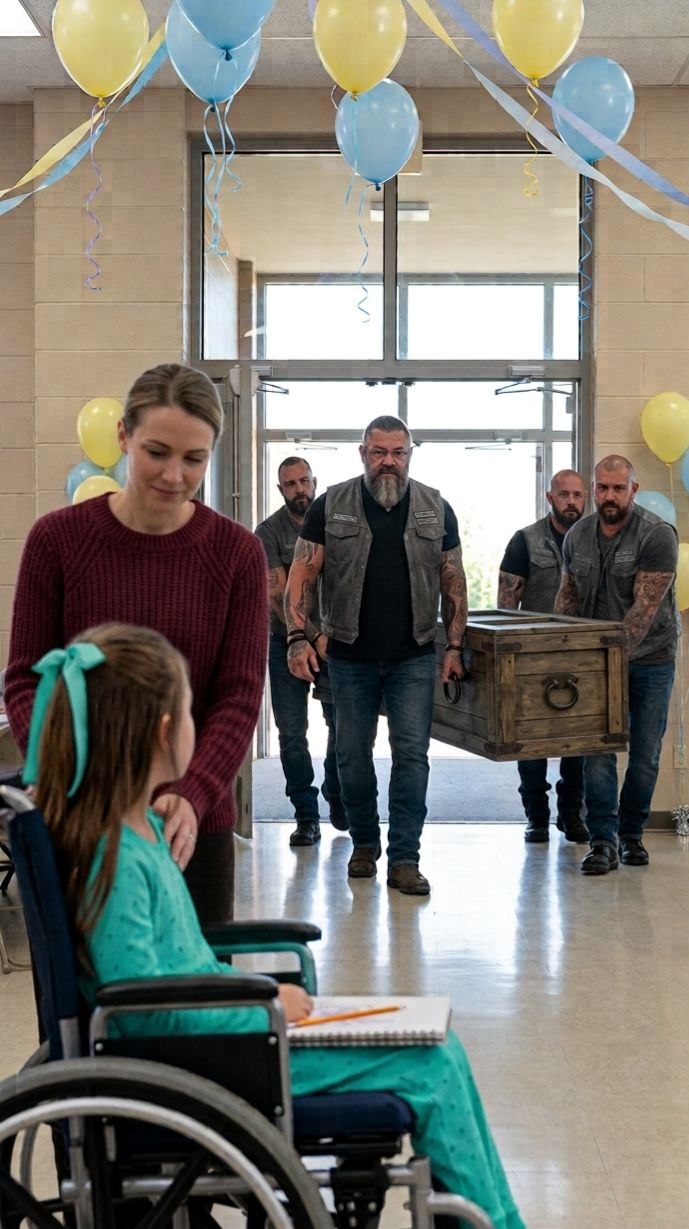
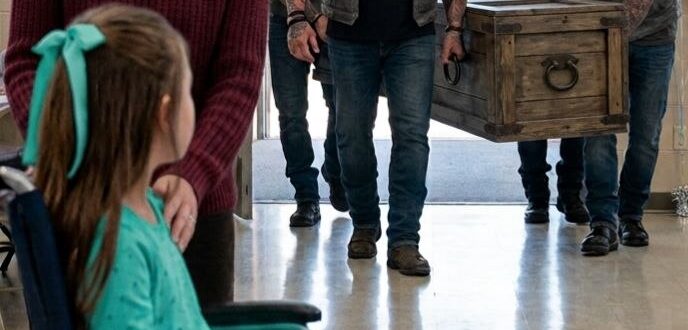
Ray Dawson walked in with six other bikers. He was an intimidating man with a gray beard, a worn leather jacket, and the kind of presence that made everyone in the room take notice.
Two of his friends were carrying a long black wooden case decorated with silver stars and a curved lid.
At first glance, it looked exactly like a child-sized coffin. Several parents instinctively stepped backward. I knew Ray.
Six weeks earlier, I had ordered him to stay away from my daughter. Now he had shown up at Maisie’s eighth birthday carrying what looked like a coffin.
But my daughter wasn’t frightened. She sat in her battered old wheelchair and stared at Ray with excitement in her eyes.
“Mom… please don’t make him leave.” The insurance company had already rejected the specialized wheelchair she needed three times.
Her current chair was damaged, uncomfortable, and becoming harder for her to use every day. Ray placed the black case in the middle of the room.
Then he pulled several sheets of paper from his jacket. They were Maisie’s drawings.
At the top of the first page, she had written: THINGS MY WHEELCHAIR NEEDS IF ADULTS WOULD JUST LISTEN.
She had drawn purple wheels, lights, a hidden compartment, a softer seat, and even a special place for her stuffed bear, Barnaby.
I stared at Ray. “Where did you get these?” “From the mailbox,” Maisie answered before he could. I looked at her. “What mailbox?” “The red one.” Ray finally admitted the truth.
They had been working together secretly for four months. Then he opened the case.
The room went silent. Inside was a wheelchair unlike anything I had ever seen. It had been custom-built specifically for Maisie. Purple wheels.
A medical-support backrest. Modified safety harnesses. A pressure-relieving cushion. A sophisticated control panel.
Every detail had been designed around her needs. My daughter covered her face and started crying. “Hammer…”
That was what she had called Ray since she was two. Then she noticed something beneath the footrest.
She reached down. A small metal plate had been attached underneath the frame. A short message was engraved on it: BUILD HER SOMETHING THAT MOVES.
I knew that handwriting. Daniel. My husband. Maisie’s father. He had been dead for five months. Ray handed me an envelope.
“Daniel gave this to me before he died.” And suddenly, everything I thought I understood began to collapse.
Daniel had known Ray for nine years. After a motorcycle accident, Ray had helped Daniel through his recovery. What started as a favor eventually became a friendship.
Ray owned a workshop where he built ramps and modified vehicles and mobility equipment for people with disabilities.
That was how he met Maisie. When she was two, she hated her first wheelchair. It was plain and gray.
Ray painted it purple, customized the wheels, and turned something she hated into something she was proud to use.
From that day forward, she called him Hammer. Then Daniel was diagnosed with pancreatic cancer.
Doctors initially told him he might have a year. He lived for only eight months.
As his condition deteriorated, the insurance company continued rejecting Maisie’s application for the specialized wheelchair she desperately needed.
Eleven days before Daniel died, he left Ray a complete set of measurements, specifications, and one simple instruction: BUILD HER SOMETHING THAT MOVES.
Ray promised he would. But Daniel had one more request. He wanted to ride his motorcycle one last time. Ray took him out for forty-three minutes.
I was drowning in grief at the time. Those forty-three minutes became the center of my anger. I convinced myself that Ray had taken advantage of Daniel when he was vulnerable.
At the funeral, I told Ray to disappear from our lives. He didn’t argue. He simply removed his Iron Mile Riders patch, placed it on the hood of my car, and walked away.
Three days later, the insurance company rejected Maisie’s wheelchair again. That was when Ray made his decision.
He was going to build it himself. The only money he had was the $812 Daniel had left behind with a note: FOR MOVEMENT, NOT FLOWERS.
With help from a specialist named Priya Shah and several members of his motorcycle club, Ray began working.
For months, Maisie secretly sent him drawings through a red mailbox.She designed her dream wheelchair piece by piece. But the project nearly failed.
A safety inspection found problems with the brakes and battery. One support was also positioned dangerously close to her ribs. They had only six days left.
Ray sold his Harley Road King—the motorcycle he had owned and cared for for twenty-three years—to pay for the replacement parts.
Finally, the wheelchair passed inspection.Maisie tested the controls. She turned. She stopped. Then she discovered a tiny button decorated with a blue motorcycle.
She pressed it. For three seconds, the sound of Ray’s Harley filled the room. Maisie burst out laughing. Then the wheelchair spoke.
It was Daniel’s voice. “Easy on the corners, Bug.” I froze.“What did you do?” Ray shook his head. “Nothing.”
The recording continued: “If you’re hearing this, Hammer has probably ignored at least six perfectly good reasons to abandon this project. Before you blame him again, open the envelope.”
My hands trembled as I read Daniel’s letter. Those forty-three minutes I had turned into an accusation had actually been Daniel’s final chance to see the project.
He had touched the frame, checked the design, and recorded messages for his daughter.
He had also left one very specific request: “Don’t put my picture on her chair. I want people looking at my daughter, not at the dead man sitting behind her.”
The final page was addressed to me. Daniel had written: “I asked Ray to endure your anger because he is strong enough to stay close to it.”
I lowered the letter. “You could have told me.” “I promised I wouldn’t.” “You lost your patch, your customers, and your motorcycle.”
Ray looked at Maisie. “The chair had to be finished.” Before I could answer, the doors opened again.
Elena Ruiz, one of Daniel’s former patients, walked in with several veterans. Behind them stood Ray’s blue Harley.
Nineteen of Daniel’s former patients and their families had pooled their money to buy it back for him. Maisie picked up Ray’s old Iron Mile Riders patch.
Then she stuck it back onto his jacket with purple tape.“Hammer, you have to wear it.” Ray smiled.
The black case that had frightened everyone that afternoon was eventually transformed into a mobile workshop for repairing mobility equipment.
That was how Move Night began. Every Thursday, families brought wheelchairs, walkers, ramps, and other mobility equipment.
Ray repaired them.Priya inspected them. The bikers transported whatever materials were needed. Nobody charged a cent. And at the center of it all was Maisie.
She would look at every child who came through the door and ask: “Where do you want to go?” It was Daniel’s question.
Years passed. Maisie outgrew that wheelchair and replaced it several times. But she kept one thing.
The little metal plate beneath the frame: BUILD HER SOMETHING THAT MOVES.
Only then did I finally understand what Ray had brought inside that black box on my daughter’s eighth birthday. It wasn’t a coffin.
It was a promise. Daniel had started it.
Ray had finished it.
I had spent months believing Ray had brought death to my daughter’s birthday.
The truth was almost the exact opposite.
He had brought her something Daniel had wanted her to have all along. Movement.