“Could you please get that cart out of here?”
He laughed at her—until he heard her last name.
Maximiliano Breton’s voice sliced through the elegant dining room.
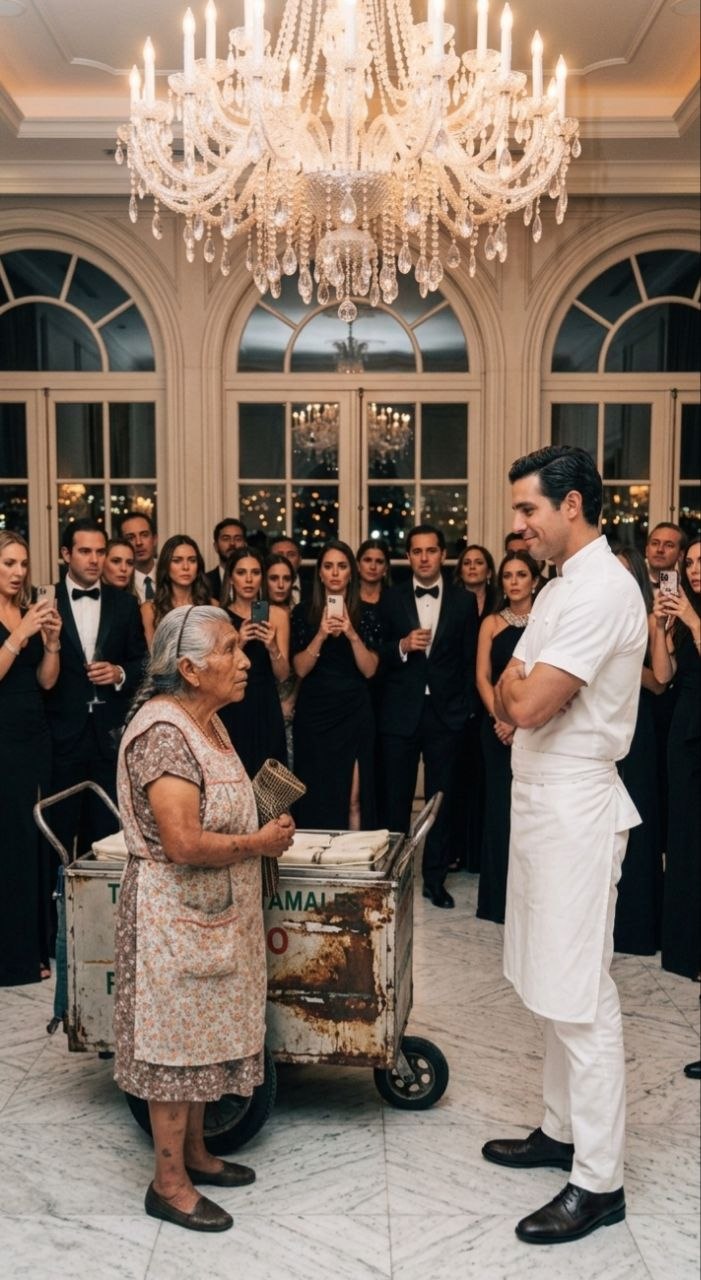
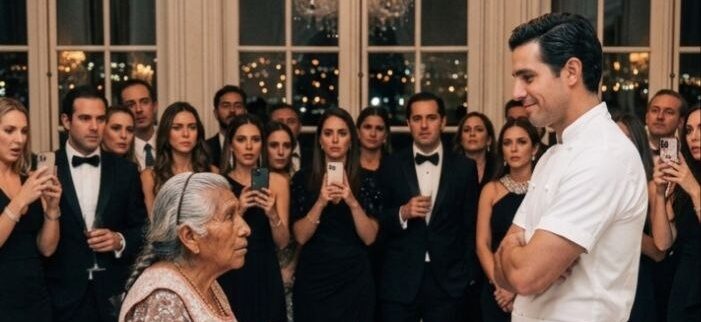
The conversations stopped as everyone turned toward the entrance. An elderly woman in her seventies had parked an old tamale cart beneath the crystal chandelier.
It was opening night at Aurora, the luxurious Polanco restaurant owned by Maximiliano—a forty-one-year-old chef whom magazines proudly called one of the brightest names in Mexican cuisine.
Maximiliano pointed toward the cart. “This is a private opening, ma’am. Not a street market.” A few guests laughed.
Doña Refugio Maldonado remained completely calm. She wore a faded apron and carried a rebozo over one arm. “I’m only here to deliver something.”
“And what exactly did you bring us? Salmonella?” Maximiliano joked. Refugio waited until the laughter faded. “I’m here on behalf of Aurora.” The smile disappeared from Maximiliano’s face.
Aurora Breton, his mother, had died fourteen months earlier. Maximiliano always told people that she had taught him how to cook on a tiny stove.
What he never revealed was where the recipe that made him famous had actually come from. “You didn’t know my mother,” he said.
“I knew her for thirty-two years. We worked together at Jamaica Market. She sold flowers, and I sold tamales. You were seven years old and used to do your homework on mango crates.”
The room fell silent. Refugio opened her rebozo and pulled out an old copper pot.
Maximiliano recognized it instantly. It was the same pot displayed in the enormous photograph of his mother hanging near the restaurant entrance.
“Where did you get that?” “It was never hers.” From inside the pot, she took out an old school notebook covered in plastic.
On the front were the words: Refugio Maldonado — 1979
“Your mother asked me to give this to you when you opened your own restaurant. She wanted me to hand it to you in front of witnesses because she knew you wouldn’t believe me if I told you privately.”
She opened the notebook to a page marked with a red ribbon. Food critic Ignacio Villalobos leaned closer and read aloud:
“House Mole. Mulato, pasilla, and ancho chiles. Almonds, sesame seeds, cinnamon, and stone-ground chocolate. The secret: toast the sesame seeds separately.”
He slowly closed the notebook. “Chef, this is your mole.” It was the signature dish that had made Maximiliano famous and earned him a Michelin star. On the menu, it cost 1,280 pesos.
But the notebook was dated 1979—six years before Maximiliano was born.
Ximena, his head of public relations, whispered urgently: “We need to shut down the cameras.” “Leave them on,” Maximiliano replied.
He looked directly at Refugio. “Did you sell this recipe to my mother?” “No.” She shook her head. “I gave it to her.”
September 19, 1985
“That day, I was forty-one years old,” Refugio continued. “The same age you are now.” No one moved.
“Your mother was nineteen. She lived in the Roma neighborhood with her husband, Ramón. She was four months pregnant.”
Refugio lowered her voice. “The building collapsed at 7:19 that morning. She survived because she had gone out to buy milk.”
Maximiliano stood motionless. “I found her three days later at the market. She was sitting on the ground beside the stalls. She had no home, no money, and no one to turn to.”
“I took her to my room in the Doctores neighborhood, and she stayed with me for three years.”
“Why?” Maximiliano asked, his voice breaking. Refugio took a slow breath.
“Because I had lost a daughter too. And because in this country, women either hold each other up or no one holds them at all.”
The room became completely silent. “I taught her how to cook on a two-burner stove. Everything she told you in those interviews was true. It just wasn’t the whole story.”
“The recipe,” Villalobos said quietly. “I gave her the complete recipe, along with the notebook. Your mother kept saying she couldn’t accept it.”
Refugio smiled faintly. “I told her that a borrowed recipe could never feed you with pride, but a gift could. If she was going to sell it, she had to call it her own.” “Why?”
“Because if she admitted it belonged to someone else, nobody would have bought it. She needed to survive.” Refugio adjusted the rebozo on her arm.
“Your mother sold mole at Jamaica Market for twenty-two years. That’s where she built the foundation for her culinary career, her trip to France, and, forgive me, even the chandelier hanging above us.”
The most celebrated chef in Mexico lowered his eyes.
The Last Page
“I still haven’t shown you everything I came here to deliver,” Refugio said. She opened the notebook again and turned to the final page.
The handwriting there was shaky. The date was from fourteen months earlier. Maximiliano recognized it immediately. It was his mother’s handwriting, written from her hospital bed.
My son, If you’re reading this, it means you’ve finally opened your restaurant. Congratulations, even though I’m not here to see it.
The woman who gave you this notebook is named Refugio. She fed me when I had nothing and you were still growing inside me. Everything I know about cooking, she taught me in a small room in Doctores.
I’m not asking you to give her money. She would never accept it. I tried for thirty years. I’m asking you for only one thing. Give her a table. Not a check. A table. Your mother, Aurora.”
The room went completely silent. Maximiliano closed the notebook and held it against his chest. Then he handed it back to Refugio.
For the first time, he understood that the story he had been telling for years had never truly belonged to him.
The Table
What Maximiliano did next shocked everyone. He walked to the entrance and personally took hold of the tamale cart. “Chef, no,” Ximena protested.
He pushed the cart across the polished marble floor, past the elegant tables and beneath the crystal chandelier.
Then he placed it beside the plaque celebrating the restaurant’s Michelin star. He returned to Refugio, pulled out a chair, and looked at her. “Doña Refugio, would you join me?”
She hesitated. “I brought tamales. They’re going to get cold.” “Then we’ll serve them.”
For several seconds, nobody spoke. Then someone began applauding. Within moments, the entire room was on its feet. Refugio sat down, still overwhelmed.
Maximiliano placed a white service towel over his arm and began serving the woman who had spent decades selling tamales at Jamaica Market while dozens of phones captured the unforgettable moment.
Epilogue
The next morning, Ignacio Villalobos published the shortest and most widely read review of his thirty-year career. He wrote that the best dish served at Aurora that night wasn’t listed on the menu.
A month later, the restaurant renamed its signature mole. It was no longer called “House Mole.”
It became: Mole Refugio.
The photograph at the entrance was changed too. Aurora was no longer pictured alone.
Now she stood beside Refugio. And every Thursday, a table by the window was reserved with a small card that read:
“Reserved for Mrs. R. Maldonado.”
Refugio came whenever she could, though not every week.
She still sold tamales at Jamaica Market, arriving at five in the morning and working until noon, just as she had done for nearly fifty years.
Whenever someone asked why she hadn’t retired, she would laugh and say:
“You don’t quit your job just because people finally applauded you.”