At My Nephew’s Birthday Celebration, I Found My Four-Year-Old Daughter Curled Up Alone in the Bathroom, Shaking as She Asked, “Daddy… Was I Bad?”
When I confronted my sister, she coldly replied, “She just needs to learn to handle things.”
I took my daughter home without saying another word.
The next morning, my mother arrived at my door in tears, begging me to protect my sister’s future—before she even asked how her own granddaughter was doing…
“Maisie?” I called softly. “Sweetheart, where are you?”
Silence. I searched the guest bedroom first, then walked toward the bathroom at the end of the hallway. The door was slightly open.
I pushed it inward—and stopped.
My little girl was wedged between the bathroom cabinet and the wall, sitting on the floor with her knees pressed tightly against her chest.
Her hands were trembling. I dropped down beside her.
“Daddy found you. You don’t have to explain anything right now. Just come here.”
She reached for me slowly.
I pulled her into my arms and immediately noticed the redness on her cheek and a few marks on her arm.
Kids fall. Kids bruise themselves. I knew that. But I also knew Maisie.
The way she buried her face against my chest and gripped my shirt as if she was afraid to let go told me this wasn’t an ordinary childhood accident.
“Did somebody hurt you?” She said nothing. I didn’t push her.
Whatever had happened, the first thing she needed was to know that I was there and that I believed her.
Downstairs, everything was still going on as if nothing had happened. I could hear children laughing in the backyard and music playing near the patio.
Corinne was standing beside our mother, Patricia, when I came downstairs.
Corinne glanced at Maisie. “What happened to her?”
I looked directly at my sister. “I was about to ask you the same thing.”
The conversation around us stopped. Corinne rolled her eyes. “It’s not a big deal. She was acting up.”
“Acting up how?” “She wouldn’t listen. I was trying to teach her some discipline.”
I tightened my hold around Maisie. “She’s four years old.”
“And you treat her like she’s made of glass,” Corinne snapped. “She needs to toughen up. The real world isn’t going to comfort her every time she cries.”
I looked down at my daughter. Then back at my sister.
“You don’t get to discipline my child. Ever again.”
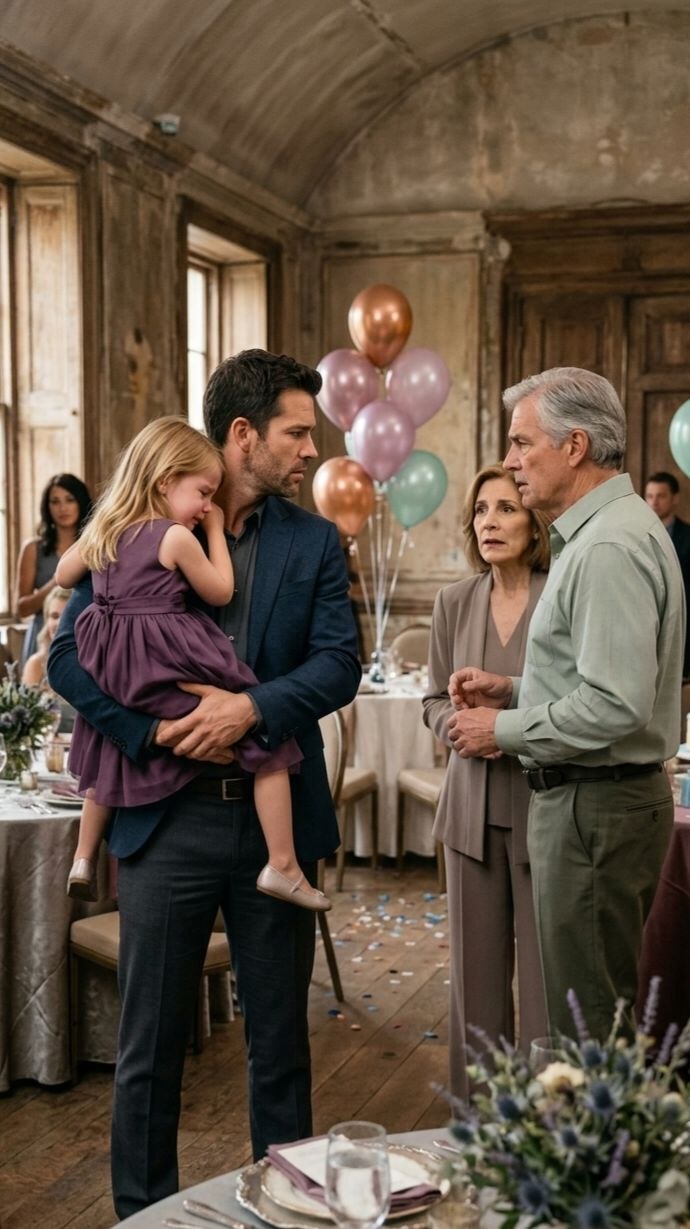
My mother immediately stepped forward. “Nolan, please. This is a birthday party. Don’t turn this into some huge family drama.”
Something inside me went completely still.
Not one person was asking why a four-year-old had hidden alone in a bathroom.
They were worried about the party.About the relatives.
About appearances. I picked up Maisie’s backpack. “We’re leaving. I’m taking her to be checked.”
My mother stared at me. “Over this?” I met her eyes.
“If you honestly think this is something small enough to ignore, then the problem is much bigger than I thought.”
At the clinic, Maisie was examined, and the findings were documented.
I followed the medical and safety recommendations given to me and made sure she was protected from further contact while everything was being addressed properly.
That night, after I tucked her into bed, she looked up at me. “Daddy… are you angry with me?”
My heart broke. “No, sweetheart. Never.”
“Even though everyone was upset?”
“Even then.” The next morning, Mom showed up at my house.
She didn’t ask how Maisie had slept. She didn’t ask whether she was hurting. Her first concern was Corinne.
“Your sister has a job. She has a son. If this gets out of control, it could ruin everything for her.”
I stared at her.“Mom… how is Maisie?”
She stopped talking.I shook my head. “That should have been the first thing you asked.”
“But Corinne is your sister!”
“And Maisie is my daughter.” “You’re going to tear this family apart.”
“No,” I said. “I’m making sure my daughter is safe.”
In the weeks that followed, some relatives tried to convince me to forgive Corinne and move on.
I stopped defending my decision.
I simply followed professional advice, updated the list of people authorized to pick up Maisie, ended unsupervised contact, and stopped bringing her to family gatherings.
I also found a child therapist who could help her process what had happened and feel secure again.
The recovery wasn’t immediate.
For a while, Maisie became uneasy whenever a bathroom door was closed. Some nights, she’d wake up frightened and call for me.
I never told her she was being dramatic. I never told her to forget about it.
I’d simply sit beside her and say, “You’re home, Maisie. You’re safe. Daddy’s right here.”
Little by little, she began to heal.
The situation eventually moved through the appropriate legal channels.
The documentation, professional assessments, and statements were considered, and protective restrictions were established.
Months later, my mother confronted me again. “I hope you’re happy with what you’ve done to your sister.”
I answered calmly. “Do you understand what happened to your granddaughter?”
She looked away. “You chose this over your family.”
“No,” I said. “I chose my daughter. You’re the one who decided those things couldn’t exist together.”
Her expression hardened. “Maybe you’re not the son I thought you were.”
For the first time, those words didn’t hurt. “Maybe,” I replied, “I’m finally becoming the father my daughter needs.”
Time passed. Maisie slowly became herself again.
Her laughter returned. She slept through the night more often. Little things stopped frightening her.
One evening, while we were getting ready for bed, she asked, “Daddy… are Grandma and Aunt Corinne still our family?”
“They’re related to us,” I said carefully.
She thought about that. “Is that the same thing?”
I smiled. “Not always.”
“Then what makes someone family?” I brushed her hair away from her face.
“Someone who makes you feel loved. Someone who respects you. Someone who makes you feel safe—and stays when you need them.”
She smiled. “Then we’re still a family.”
I kissed her forehead. “Always.”
I used to believe being loyal to your family meant forgiving everything, staying quiet, and protecting everyone’s reputation.
My daughter taught me differently. Sometimes love means forgiveness. Sometimes it means staying.
And sometimes, the most loving thing you can do is walk away with your child in your arms and refuse to return until their safety comes first.
Our home became calmer. Warmer. Happier. Every now and then, before falling asleep, Maisie still asks the same question.
“You’ll come if I need you, right?” “Every single time.” Because children may forget the balloons, the cake, and the presents.
But they remember who noticed when they were afraid. They remember who believed them.
And they remember who chose their safety when everyone else wanted to pretend nothing had happened.
A family’s reputation is never more important than a child’s sense of safety.
Setting a boundary isn’t always cruelty. Sometimes, it’s the purest form of love.