My sister snatched my work bag and hurled it into the Elizabeth River in front of sailors, contractors, and an NCIS agent.
“It was just a work bag,” Delphine insisted. “I had no idea what was inside.”
“You were explicitly warned.”
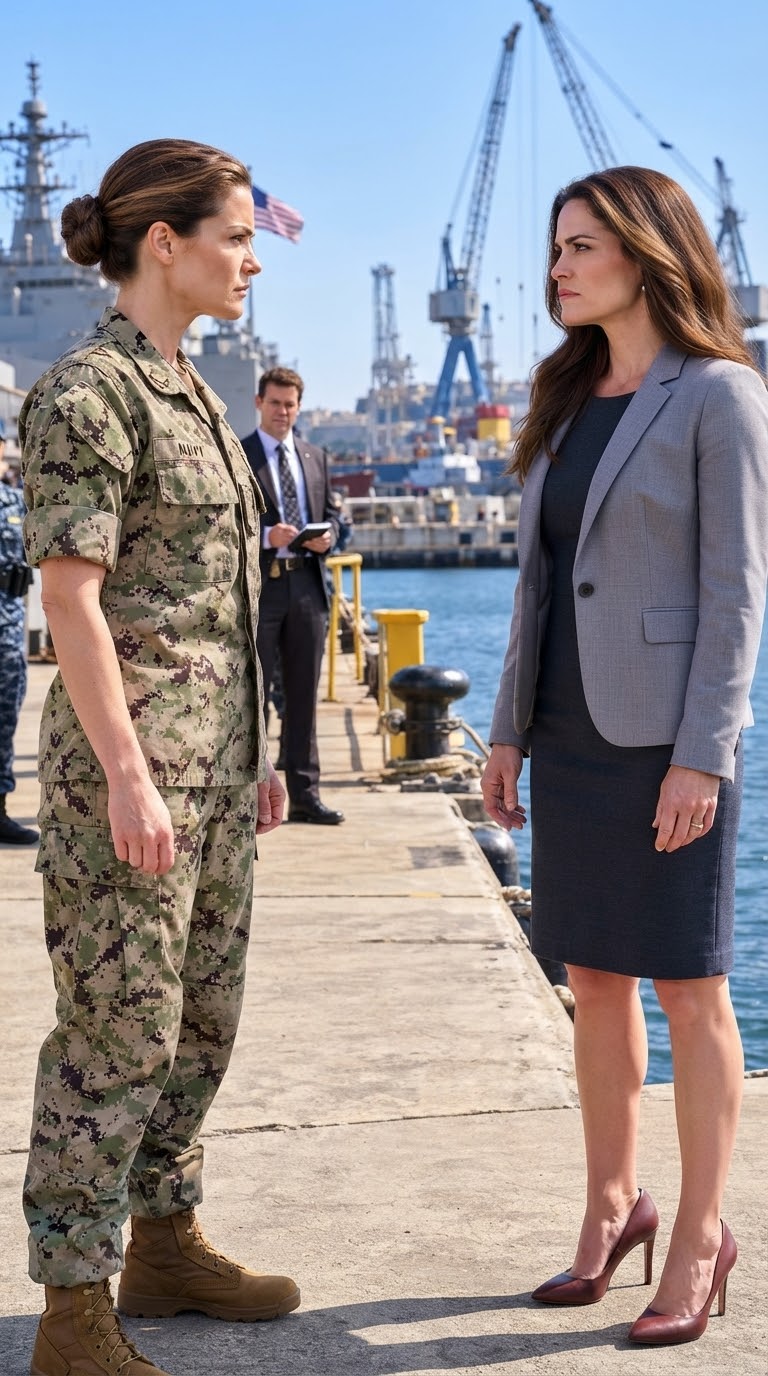
“I thought she was exaggerating.” Bell turned toward me.
“The bag contained a government inspection tablet, federal documents, and assessment records concerning this facility.”
By then, the bag had disappeared beneath the cold, gray water. Harbor patrol was assembling a recovery team, while Rosalind carefully recorded every detail in the official inspection log.
For most of my life, Delphine had been able to turn family members against me. I had learned to survive by keeping quiet.
Standing there, I finally wondered whether my silence had ever created peace—or merely allowed problems to grow unchecked.
Bell began questioning Delphine about how she had gained access to the pier.
She claimed Barton Maritime Services had hired her to cater the retirement event.
Rosalind immediately interrupted. “Barton Maritime isn’t on the approved vendor list.”
Delphine quickly pulled out her phone and showed Bell the messages she had received.
The instructions told her to enter through the west service gate and stay away from the main entrance.
Something suddenly clicked in my mind. Before Delphine arrived, I had noticed that my work bag looked different inside my locked vehicle.
I had assumed I was simply remembering it incorrectly. Then the recovery team surfaced. The diver handed us the bag.
The tablet was still working. But Appendix C—the waterfront vendor access log—was missing. Bell examined the tablet’s activity history.
His expression changed. “At 8:12, someone unlocked the device.”
He scrolled again. “Two minutes later, a file was transferred to an external device.”
“Which file?” I asked. “Appendix C.” I looked at the time. Delphine had thrown my bag into the river at 8:25.
Someone had accessed it before she ever touched it. Then Delphine remembered something else.
A man had approached her beside her catering van.
He had been wearing a dark jacket and a baseball cap. According to Delphine, he told her that I was trying to ruin her business.
He also knew surprisingly personal details about our family.
Most importantly, he told her not to let me “interfere.” One name immediately came to mind.
Graham Pike, the consortium’s logistics director. But the evidence didn’t seem to fit.
Inside Appendix C was a handwritten note in my own handwriting: Access approved by someone inside.
Below it, I had circled one name. Rosalind Vega. Rosalind immediately denied authorizing the access.
Then the system logs told a different story. Her credentials had been used at 7:58, 8:01, and 8:10.
But Rosalind had been inside a conference room during all three timestamps, surrounded by witnesses.
She finally admitted something she had forgotten to report.
The previous afternoon, her access badge had disappeared for several minutes. Later, she found it in the copier room.
And Graham Pike had been standing there when she retrieved it. The tablet revealed another disturbing sequence.
Rosalind’s credentials had been used at the west service gate at 8:09.
Two minutes later, those same credentials were used at the administrative building.
Security footage showed a white catering van passing through the gate.
Moments later, a man wearing a dark jacket and baseball cap entered the administrative building.
He was carrying a slim black case. A badge was clipped to his belt. Rosalind stared at the screen.
“That’s a federal visitor credential,” she whispered. The technician slowed the footage and advanced it frame by frame.
For less than a second, the camera captured the side of the man’s face. Delphine stepped closer to the monitor.
“That’s him,” she said quietly. “That’s the man who spoke to me.” Bell froze the frame.
Master Chief Kettleman leaned toward the screen. Then his expression hardened.
“Commander,” he said carefully, “that isn’t Graham Pike.” “No,” I replied.
Bell enlarged the image and focused on the credential hanging from the man’s belt.
The printed name was barely readable. But it was enough.
M. Vale. My surname. My family name.
And suddenly, the question was no longer about who had thrown my bag into the river.
The real question was much more disturbing: Who had been inside the operation from the very beginning?