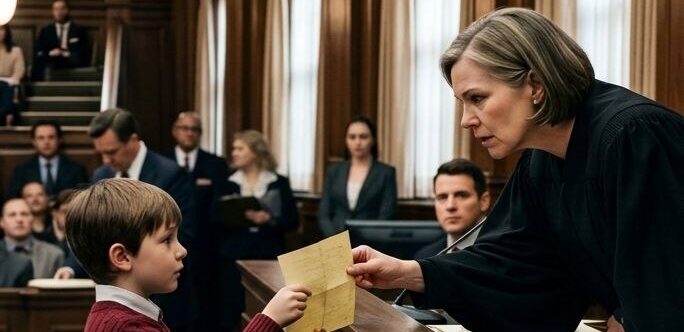
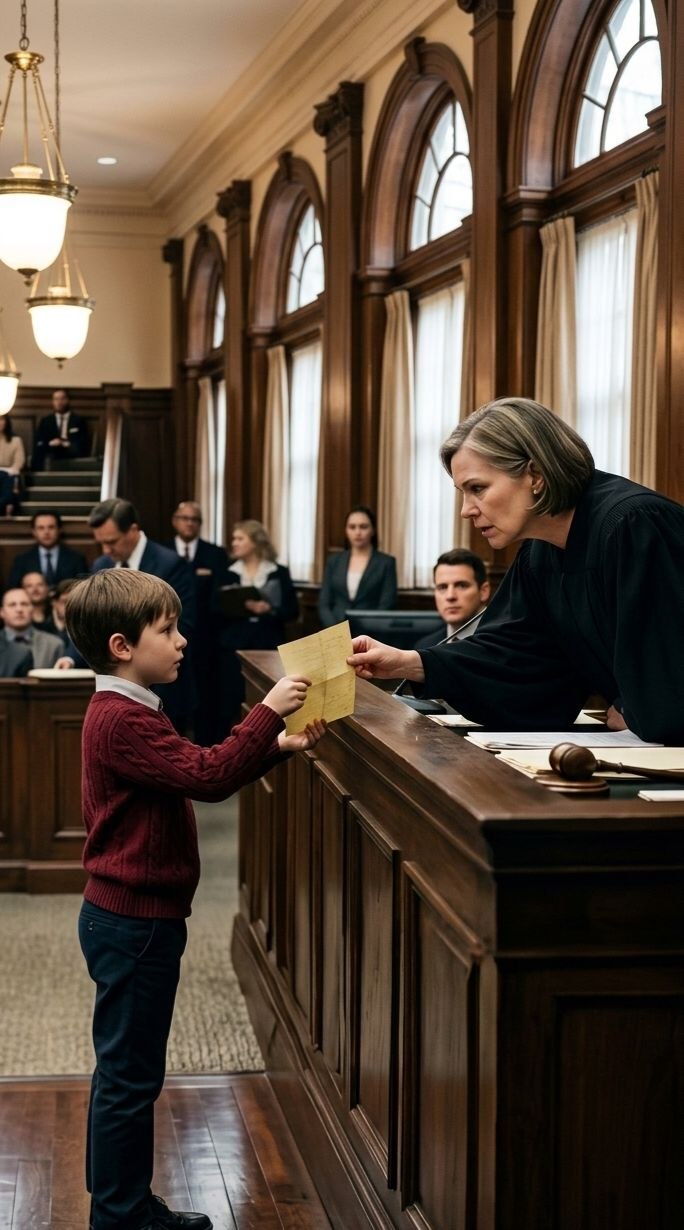
An 8-Year-Old Boy Walked Into the Courtroom With a Mysterious Note — No One Expected What Happened Next
The Boy Who Uncovered a Hidden Truth
“Mateo,” Judge Elena said softly, “your grandmother didn’t leave you a game. She left you the truth.”
Outside, the rain began to fall. That same morning, investigators from the prosecutor’s office arrived at the Palace of Justice.
They examined the note, the key, the old case file, and the small map Mateo had found inside his grandmother’s book.
The map pointed to a storage unit outside Morelia, near the road to Pátzcuaro.
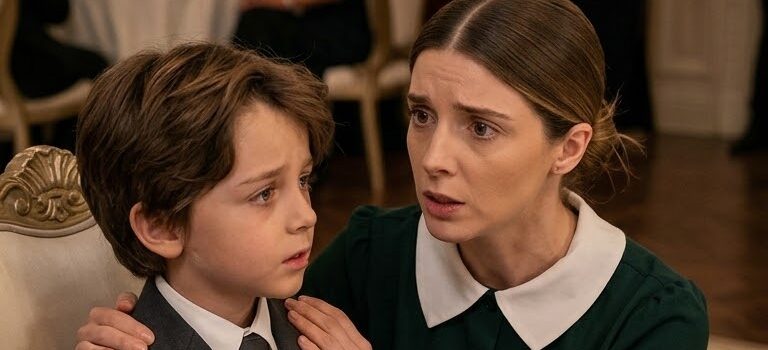
When Lucía, Mateo’s mother, learned that her son had missed school, she rushed to the courthouse in panic.
The moment she saw him standing beside the judge, she pulled him into a tight embrace. “What did you do, my love?”
Mateo simply pointed to the note. “Grandma asked me to come here.”
Lucía immediately recognized Carmen’s handwriting. She remembered how her mother had spent her final years repeating that some promises were too important to be buried with the dead.
No one had imagined that she was talking about a real case. That afternoon, investigators arrived at storage unit 214.
The place looked abandoned: rusted doors, overgrown weeds, and puddles covering the ground from the endless rain. The manager insisted that nobody had opened the unit in more than seven years.
When the key finally turned in the lock, everyone held their breath. Inside, there were no old pieces of furniture or forgotten boxes.
There was only one thing: A red suitcase sitting in the center of the room. When they opened it, they found carefully organized envelopes, photographs, notebooks, official documents, and bank records.
The names appearing throughout the files were Daniel Robles, Roberto Castillo, and Tomás Villaseñor.
Daniel had been an investigative journalist who disappeared seven years earlier while preparing a report about a financial scandal that had destroyed the life of Roberto Castillo, an accountant who had been falsely accused of altering financial records.
Daniel never had the chance to publish the evidence proving Roberto’s innocence.
At the bottom of the suitcase, investigators found a photograph of Daniel standing beside Carmen Sánchez.
On the back, a message was written: “If anything happens to me, Carmen will know where to look.”
Judge Elena received a letter from Carmen explaining that Daniel had trusted her with the documents because she knew the court’s archives.
She had tried to reveal the truth, but every attempt was blocked and the evidence mysteriously disappeared.
Fearing for her family’s safety, Carmen hid the suitcase and waited for the right moment.
The letter also mentioned a witness living in a small village near the lake.
Following the clue, investigators traveled to Janitzio, where they found Arturo Leal, an elderly man who had preserved Daniel’s original letters for years.
The documents revealed that several powerful businessmen had manipulated accounts to hide illegal activities.
One of the names mentioned was Tomás Villaseñor, a respected figure in Morelia known for his charitable work. But the biggest revelation came afterward.
The signature appearing most often on the documents belonged to Héctor Pineda, a former head of archives at the Palace of Justice.
Héctor had disappeared shortly after Daniel vanished. After four days of searching, authorities found him in Querétaro. When they opened the door, he said only: “You took too long.”
Héctor confessed that he had not killed Daniel, but he had helped hide the truth. He admitted that he knew Roberto was innocent but was too afraid to confront the people protecting the fraud.
“I was a coward,” he said through tears. “I was afraid for my family.”
Inside his home, investigators discovered a metal box containing the original evidence: financial audits, transfer records, and a signed statement from Daniel.
The truth finally came to light. Weeks later, the Palace of Justice was filled with people.
After seven years of living under suspicion, Roberto Castillo finally heard the official verdict: he was innocent.
The records had been altered, and everyone involved faced charges for fraud, falsification, and covering up the crime.
When the judge officially cleared his name, Roberto broke down in tears as he embraced his family.
Then Elena took out one final envelope found inside Carmen’s diary. It was addressed: “For Mateo, when I am no longer afraid.” The judge opened the letter and read:
“My dear Mateo. If you are hearing these words, it means the truth has finally found its way. Courage is not measured by age, but by the strength of your heart.”
Mateo quietly wiped away his tears. “I chose you because you always asked why we should do the right thing, even when nobody is watching. Today, you know the answer.”
Roberto walked toward the boy and knelt in front of him.“Your grandmother gave me back my name. And you gave me back my life.”
Mateo could only hug him. Months later, Roberto opened a community library in honor of Carmen and Daniel.
At the entrance, a plaque was placed: “The truth also needs guardians.” From that day on, Mateo often returned with his grandmother’s old book in his hands.
He no longer saw the note as a burden. He saw it as a bridge connecting the past and the future.
Because everyone remembered the eight-year-old boy who walked into the courthouse carrying a small folded note… and walked out carrying the truth of an entire city.